Technical GuideJuly 15, 202612 min read
Complete Guide to UAV GNSS Anti-Jamming Technology
A comprehensive technical analysis of GNSS interference threats facing modern UAVs and the advanced countermeasures — from CRPA arrays to adaptive null-steering — that ensure reliable navigation in contested electromagnetic environments.
Unmanned Aerial Vehicles (UAVs) have become indispensable across military reconnaissance, commercial delivery, agricultural monitoring, and critical infrastructure inspection. Yet their reliance on Global Navigation Satellite System (GNSS) signals — GPS, GLONASS, Galileo, and BeiDou — exposes them to a growing spectrum of electromagnetic threats. From low-cost jamming devices to sophisticated spoofing attacks, the integrity of UAV navigation hangs in the balance. This guide examines the threat landscape, the physics of interference, and the state-of-the-art anti-jamming technologies that protect UAV missions.
1. Understanding GNSS Interference Threats

Figure 1: GNSS Interference Threat Classification — Jamming vs. Spoofing attack types and corresponding countermeasures
GNSS signals arrive at Earth's surface at approximately -160 dBW — weaker than ambient thermal noise. This extreme vulnerability makes satellite navigation signals easy targets for deliberate interference and accidental disruption.
1.1 Jamming Attacks
Jamming involves transmitting high-power RF signals on GNSS frequencies (L1: 1575.42 MHz, L2: 1227.60 MHz, L5: 1176.45 MHz) to overwhelm the receiver's front-end. Common jamming types include:
- Continuous Wave (CW) Jamming: A single-tone carrier that desensitizes the receiver's RF front-end, raising the noise floor and preventing signal acquisition.
- Wideband Noise Jamming: Broadband noise spanning the entire GNSS bandwidth, effectively drowning all satellite signals in the affected band.
- Chirp Jamming: A rapidly frequency-sweeping signal that creates wideband interference across multiple GNSS bands, particularly difficult to filter.
- Pulse Jamming: Short, high-power bursts that disrupt signal tracking without continuous transmission, harder to detect and mitigate.
Technical Insight
A commercial GPS jammer with 1W output power can deny GNSS service within a 5-10 km radius in open environments. Military-grade jammers with directional antennas and higher power can extend this envelope to 50+ km, creating vast no-fly zones for GNSS-dependent UAVs.
1.2 Spoofing Attacks
Spoofing is more insidious than jamming. Rather than denying service, the attacker generates counterfeit GNSS signals that the receiver mistakes for authentic satellites. The UAV's navigation system calculates a false position, velocity, and time (PVT) solution — all while the pilot believes everything is normal.
Spoofing techniques include:
- Meaconing: Recording legitimate GNSS signals and rebroadcasting them with time delay to shift the receiver's calculated position.
- Generator Spoofing: Software-defined radio (SDR) platforms generating synthetic GNSS signals with arbitrary navigation messages, enabling precise trajectory manipulation.
- Overlay Attacks: Superimposing counterfeit signals on authentic ones, gradually pulling the receiver's tracking loops toward the false signals.
2. Anti-Jamming Architecture for UAVs
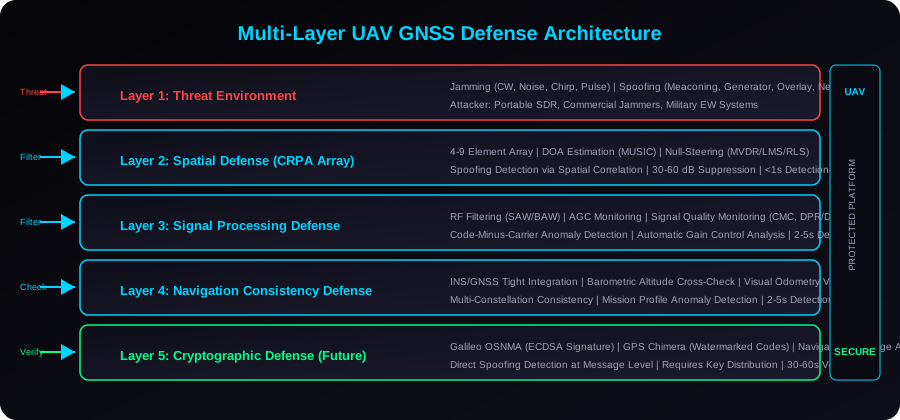
Figure 2: Multi-Layer Defense Architecture — From spatial CRPA arrays to cryptographic navigation message authentication
Effective UAV anti-jamming requires a multi-layer defense architecture operating across RF, signal processing, and navigation algorithm levels. No single technique is sufficient against the full threat spectrum.
| Defense Layer | Technique | Jamming Suppression | Complexity |
|---|
| RF Front-End | SAW/BAW Filtering, AGC | 10-20 dB | Low |
| Antenna Array | CRPA with Null-Steering | 30-50 dB | Medium |
| Adaptive Processing | MVDR, STAP, LMS | 40-60 dB | High |
| Navigation | INS/GNSS Tight Integration | 20-30 dB (indirect) | High |
3. Controlled Reception Pattern Antennas (CRPA)
The Controlled Reception Pattern Antenna (CRPA) represents the gold standard for UAV anti-jamming protection. Unlike conventional passive antennas that receive signals from all directions equally, CRPAs dynamically shape the reception pattern to suppress signals from jamming directions while maintaining gain toward legitimate satellites.
3.1 CRPA Architecture
A typical CRPA system for UAVs consists of:
- Antenna Array: 4 to 9 element arrays arranged in compact geometries (typically λ/2 spacing) optimized for UAV payload constraints.
- RF Front-End: Low-noise amplifiers (LNA) with high dynamic range, automatic gain control (AGC), and anti-aliasing filters.
- Digital Beamformer: FPGA or ASIC-based real-time weight computation engine executing null-steering algorithms.
- GNSS Receiver: Modified receiver baseband capable of processing spatially-filtered signals from multiple RF channels.
3.2 Null-Steering Algorithms
The core of CRPA operation is the weight computation algorithm that determines how signals from each antenna element are combined. The objective is to place radiation pattern nulls (deep attenuation) in jamming directions while preserving gain for satellite signals.
Minimum Variance Distortionless Response (MVDR)
The MVDR beamformer minimizes the total output power subject to the constraint that the gain in the desired signal direction remains unity. Mathematically: w = R⁻¹a / (aᴴR⁻¹a), where R is the spatial covariance matrix and a is the steering vector. MVDR achieves optimal interference suppression when the jammer-to-signal ratio exceeds 30 dB.
Other widely used algorithms include:
- Least Mean Squares (LMS): Adaptive gradient-descent algorithm with low computational complexity, suitable for FPGA implementations with limited resources.
- Recursive Least Squares (RLS): Faster convergence than LMS, tracking rapidly moving jammers (critical for UAVs in dynamic environments), at higher computational cost.
- Space-Time Adaptive Processing (STAP): Extends spatial filtering with temporal filtering, effective against wideband and frequency-sweeping jammers.
4. UAV-Specific Anti-Jamming Considerations
UAV platforms impose unique constraints on anti-jamming system design. Unlike ground vehicles or maritime platforms, drones face severe Size, Weight, and Power (SWaP) limitations, platform dynamics, and aerodynamic interference.
4.1 Size, Weight, and Power (SWaP)
Consumer and tactical UAVs demand anti-jamming solutions under 100g and 5W power draw. This drives adoption of:
- Compact 4-element CRPA arrays with microstrip patch antennas
- High-integration RFICs combining LNA, mixer, and ADC in single packages
- Low-power FPGA beamformers (Xilinx Zynq UltraScale+, Intel Agilex)
- Embedded Linux SoCs for algorithm hosting
4.2 Platform Dynamics
UAVs experience rapid attitude changes (roll, pitch, yaw rates exceeding 100°/s in agile platforms), vibration, and aerodynamic loading. CRPA systems must incorporate:
- Attitude compensation: INS integration to rotate antenna array coordinates into the navigation frame, maintaining null accuracy during maneuvers.
- Vibration isolation: Mechanical damping mounts to prevent microphonics and antenna element displacement.
- Calibration tables: Pre-flight antenna array manifold calibration to compensate for installation-specific electromagnetic effects.
4.3 Multi-Constellation Resilience
Modern UAVs benefit from multi-constellation GNSS (GPS + GLONASS + Galileo + BeiDou). CRPA systems that protect across all constellations simultaneously provide redundancy: even if one constellation is completely jammed, navigation can continue on others. Multi-band CRPAs (L1/L2/L5) offer additional protection against band-selective jammers.
5. Spoofing Detection and Mitigation
Anti-jamming alone does not address spoofing. Since spoofing signals are structurally identical to authentic GNSS signals, traditional power-based detection fails. Advanced spoofing detection methods include:
- Array-based Spoofing Detection: Authentic satellites arrive from diverse directions; spoofing signals typically originate from a single direction. CRPA arrays can detect spatial correlation anomalies indicating spoofing.
- Signal Quality Monitoring (SQM): Metrics like Delta Pseudo-Range/Delta Carrier Phase (DPR/DCP) and Code-Minus-Carrier (CMC) detect signal distortion characteristic of spoofing.
- Consistency Checks: Comparing GNSS-derived position with INS, altimeter, or visual navigation estimates. Divergence beyond statistical thresholds triggers spoofing alerts.
- Navigation Message Authentication (NMA): Galileo OSNMA and GPS Chimera provide cryptographically signed navigation data, enabling direct spoofing detection at the message level.
6. Regulatory and Compliance Landscape
UAV anti-jamming systems must navigate export control regulations (ITAR/EAR in the US, EU dual-use regulations), frequency allocation rules, and certification requirements. CRPA systems with spatial nulling capabilities are often classified as dual-use items due to their potential military applications. Manufacturers must ensure compliance with destination country regulations before export.
7. Future Trends
The UAV anti-jamming landscape continues to evolve rapidly. Key emerging trends include:
- AI-Enhanced Beamforming: Deep learning models trained on jammer signatures to predict interference patterns and optimize null placement faster than traditional adaptive algorithms.
- Software-Defined CRPA: SDR-based CRPA platforms enabling field-upgradable algorithms and rapid response to new jamming waveforms.
- Collaborative Anti-Jamming: Swarm UAVs sharing interference environment data to collectively optimize spatial filtering across the formation.
- Quantum-Enhanced Sensing: Rydberg atom-based RF sensors offering unprecedented sensitivity and direction-finding precision for next-generation CRPA receivers.
Protect Your UAV Fleet
GMC CRPA delivers military-grade anti-jamming and anti-spoofing protection in compact, SWaP-optimized packages designed for UAV integration.
Explore CRPA Products