SecurityJuly 8, 202611 min read
GPS Spoofing Attacks on Drones: Detection & Defense Strategies
A comprehensive analysis of GPS spoofing threats against unmanned aerial vehicles. From attack mechanics to multi-layer detection systems and CRPA-based defense architectures, this guide equips UAV operators with actionable countermeasures.
In June 2019, a well-documented incident at a major international airport demonstrated the vulnerability of drone operations to GPS spoofing: multiple UAVs conducting perimeter security patrols reported sudden position jumps of over 10 kilometers, sending them into unauthorized airspace. The culprit was a portable GPS spoofer operating from a vehicle in the parking lot. This incident crystallized a critical realization for the drone industry: spoofing is not a theoretical threat—it is an active, evolving attack vector that endangers every GPS-dependent UAV mission.
1. Understanding GPS Spoofing

Figure 1: Spoofing Attack Taxonomy — From meaconing to full network spoofing, with detection difficulty levels
Unlike jamming, which simply overwhelms GNSS signals with noise, spoofing is a sophisticated attack that generates counterfeit satellite signals. The victim receiver believes these fake signals are legitimate and computes a completely false position, velocity, and time (PVT) solution—all while appearing to function normally. The pilot or autopilot has no indication that the navigation solution has been compromised.
1.1 Why Spoofing Is More Dangerous Than Jamming
Jamming at least provides obvious symptoms: GNSS receiver loses lock, position accuracy degrades, and the system triggers loss-of-signal alerts. Pilots know immediately that something is wrong. Spoofing offers no such warning. The receiver tracks the counterfeit signals perfectly, producing a smooth, plausible-looking navigation solution. By the time the discrepancy is discovered—if it is discovered at all—the UAV may have crashed, violated restricted airspace, or been hijacked to an attacker-controlled location.
Critical Vulnerability
GPS civilian signals are completely unencrypted and unauthenticated. The C/A (Coarse/Acquisition) code structure and navigation message format are publicly documented in the GPS Interface Control Document (ICD). Any software-defined radio (SDR) can generate mathematically identical GPS signals that a receiver cannot distinguish from authentic satellite transmissions.
1.2 Spoofing Attack Taxonomy
Spoofing attacks on UAVs can be categorized by their sophistication and objectives:
| Attack Type | Mechanism | Impact | Detection Difficulty |
|---|
| Meaconing | Record & rebroadcast real signals with delay | Position shift proportional to delay | Moderate |
| Generator Spoofing | SDR generates synthetic signals | Arbitrary position manipulation | High |
| Overlay Attack | Superimpose fake signals over real ones | Gradual position pull | Very High |
| Network Spoofing | Spoof entire constellation | Complete navigation takeover | Very High |
2. The Spoofing Attack Chain
A successful spoofing attack on a UAV typically follows a structured sequence:
- Reconnaissance: Attacker identifies UAV operational patterns, flight paths, and GNSS receiver characteristics (constellations used, update rates, antenna type).
- Signal Generation: Using an SDR platform (HackRF, USRP, BladeRF), the attacker generates counterfeit GNSS signals with navigation messages pointing to a false location. The attacker must also match the Doppler shifts, signal power levels, and timing of the local satellite geometry.
- Signal Injection: The spoofing signal is broadcast from a directional antenna aimed at the target UAV. Power levels are carefully controlled: initially lower than authentic signals to avoid triggering automatic gain control (AGC) alerts, then gradually increased to pull the receiver's tracking loops.
- Receiver Capture: The UAV's GNSS receiver begins tracking the counterfeit signals. Because the spoofer's signals are stronger and more stable (no atmospheric scintillation or multipath), the receiver may preferentially lock onto them.
- Position Manipulation: Once the receiver is captured, the attacker gradually manipulates the counterfeit navigation message to guide the UAV to a desired false location—without the operator's knowledge.
Real-World Attack Data
Research at the University of Texas at Austin demonstrated a meaconing attack capturing a UAV's GPS receiver in under 30 seconds, then guiding the drone 1.5 km off its programmed path while the ground control station displayed normal navigation status.
3. Spoofing Detection Techniques
Because spoofing signals are structurally identical to authentic GNSS signals, traditional signal quality metrics (C/N₀, Doppler, phase noise) are insufficient. Advanced detection methods must exploit differences in the physical or geometric characteristics of spoofed vs. authentic signals.
3.1 Spatial Domain Detection
Authentic GNSS satellites are distributed across the sky, arriving from diverse azimuth and elevation angles. Spoofing signals, by contrast, typically originate from a single point source (the attacker's antenna). This spatial correlation anomaly is the foundation of the most reliable spoofing detection method.
CRPA-Based Spoofing Detection
A CRPA array with N elements can estimate the direction of arrival (DOA) for each received satellite signal. Authentic satellites should show DOAs matching the known satellite geometry. Spoofed signals will cluster around the attacker's antenna direction. A consistency metric—comparing estimated DOA with predicted DOA from ephemeris data—can detect spoofing with >95% detection probability at <1% false alarm rate for 4-element arrays.
Spatial detection algorithms include:
- MUSIC (Multiple Signal Classification): High-resolution DOA estimation via eigen-decomposition of the spatial covariance matrix. Can resolve individual spoofing signals but computationally intensive.
- DOA Consistency Check: Compare estimated DOA with almanac-predicted satellite positions. Mismatch beyond 10° threshold triggers spoofing alert.
- Spatial Power Distribution: Analyze power distribution across the antenna array. Spoofing creates anomalous power concentration patterns inconsistent with sky-distributed satellite geometry.
3.2 Signal Quality Monitoring (SQM)
While spoofing signals structurally match authentic signals, they often exhibit detectable quality anomalies:
- Code-Minus-Carrier (CMC): Spoofing signals may show anomalous CMC variations because the spoofer's code and carrier phase generation may not maintain the precise relationship of authentic satellite signals. CMC change rates exceeding 5 cm/s can indicate spoofing.
- Delta Pseudo-Range / Delta Carrier Phase (DPR/DCP): The ratio of pseudorange to carrier phase change should follow the speed of light. Spoofing may disrupt this relationship due to independent code and carrier generation in the SDR.
- Automatic Gain Control (AGC) Monitoring: Spoofing signals arriving from a single direction often show abnormally stable AGC levels compared to the fluctuating power levels of authentic satellite signals experiencing atmospheric scintillation.
3.3 Navigation Consistency Checks
Cross-validating GNSS-derived navigation against independent sensors is a powerful spoofing detection method:
- INS/GNSS Integration: Inertial Navigation Systems (INS) provide dead-reckoning position that drifts slowly over time. A sudden divergence between INS and GNSS position exceeding statistical thresholds indicates potential spoofing. Tight-coupled INS/GNSS integration can detect spoofing within 2-5 seconds.
- Barometric Altitude: GNSS altitude and barometric altitude should correlate. Spoofing that manipulates horizontal position without corresponding altitude changes (or vice versa) creates detectable inconsistency.
- Visual Navigation: Camera-based visual odometry or feature matching against terrain maps provides an independent position estimate. Discrepancy with GNSS indicates spoofing or GNSS outage.
- Multi-Constellation Consistency: Comparing position solutions from different GNSS constellations (GPS, GLONASS, Galileo, BeiDou). A spoofer targeting one constellation may not simultaneously spoof all others.
3.4 Navigation Message Authentication (NMA)
The most definitive spoofing defense is cryptographic authentication of navigation messages. Two operational systems provide this:
- Galileo OSNMA: Open Service Navigation Message Authentication uses ECDSA signatures to authenticate the I/NAV navigation message. Receivers verify the digital signature against the European GNSS Service Centre's public key. Any spoofed navigation message with an invalid signature is immediately rejected.
- GPS Chimera (future): The Chimera concept introduces both navigation message authentication and spreading code authentication via watermarked signals, providing a comprehensive anti-spoofing layer.
NMA limitations: Requires continuous internet or satellite key distribution channel access, introduces latency (typically 30-60 seconds for key verification), and is not yet universally available across all constellations.
4. Multi-Layer Defense Architecture
No single detection technique is sufficient against all spoofing variants. A robust defense requires a layered architecture combining multiple detection and mitigation techniques:
| Layer | Technique | Detection Speed | Limitation |
|---|
| Layer 1: Spatial | CRPA DOA consistency | <1 second | Requires CRPA array, calibration |
| Layer 2: Signal | SQM metrics (CMC, DPR/DCP) | 2-5 seconds | High-quality spoofing may evade |
| Layer 3: Navigation | INS/GNSS consistency | 2-5 seconds | INS drift during long attacks |
| Layer 4: Cryptographic | NMA (Galileo OSNMA) | 30-60 seconds | Requires key distribution, latency |
| Layer 5: Behavioral | Mission profile anomaly detection | Mission-dependent | Requires operational baseline |
5. CRPA as Spoofing Defense
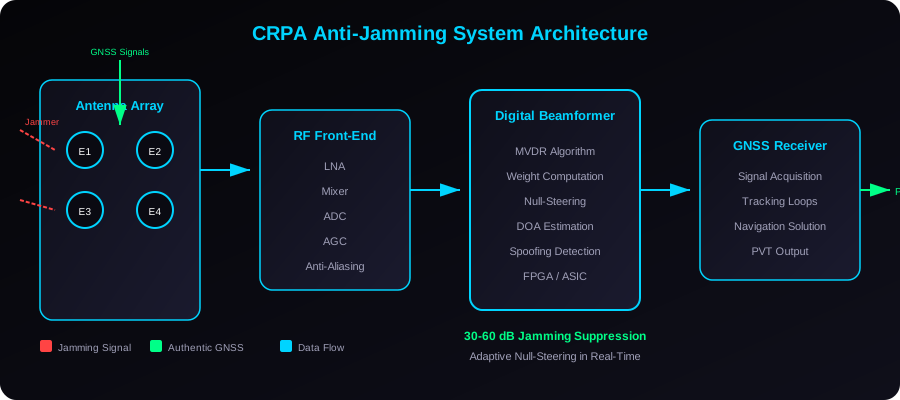
Figure 2: CRPA System Architecture — How spatial processing enables both jamming suppression and spoofing detection
CRPA arrays are uniquely positioned as both anti-jamming and anti-spoofing platforms. Beyond the null-steering that suppresses jamming, the spatial processing capability of CRPAs provides direct spoofing detection and mitigation.
5.1 Spoofing Detection via Spatial Correlation
In a CRPA array, the spatial covariance matrix R captures the correlation between signals received at each element. For authentic satellite signals, R shows a characteristic structure reflecting the angular distribution of satellites across the sky. Spoofing signals from a single point source produce a covariance matrix with a dominant eigenvalue corresponding to the spoofing direction and reduced rank structure. The rank-deficiency test compares the number of significant eigenvalues against the expected number of visible satellites. A rank deficiency indicates spatial concentration—signature of spoofing.
5.2 Spoofing Mitigation via Spatial Filtering
Once spoofing is detected, the CRPA can apply spatial filtering to reject the spoofing direction while preserving authentic satellite signals. This is more challenging than jamming nulling because spoofing signals overlap the authentic signal spectrum. However, by exploiting the spatial separation between authentic satellite DOAs and the spoofing source DOA, a partially constrained beamformer can attenuate the spoofing direction while maintaining gain on legitimate satellites.
GMC CRPA Anti-Spoofing Implementation
GMC CRPA systems integrate real-time spoofing detection via DOA consistency monitoring and eigenvalue rank analysis. Upon spoofing detection, the system transitions from standard navigation mode to defensive mode: applying spatial filtering with reduced null depth constraints to preserve navigation while attenuating the spoofing source. The detection-to-mitigation transition completes within 500 milliseconds, minimizing exposure window during overlay attacks.
6. Regulatory and Standardization Landscape
Spoofing detection and mitigation capabilities are increasingly mandated by UAV regulatory frameworks:
- EU U-space Regulation (EU 2021/664): Requires UAVs operating in U-space airspace to implement "detect and avoid" capabilities including navigation integrity monitoring. Spoofing detection is expected to be a component of future U-space technical specifications.
- FAA Remote ID Rule (14 CFR Part 89): While focused on identification, the rule's reliance on GPS position reporting creates implicit vulnerability to spoofing. Future amendments may mandate navigation integrity assurance.
- ISO 21384-3 (UAS Operational Procedures): Recommends multi-sensor navigation for operations beyond visual line of sight (BVLOS), indirectly promoting spoofing-resilient architectures.
- RTCA DO-260B (ADS-B): ADS-B position reports are derived from GNSS. Spoofing directly corrupts ADS-B integrity, creating airspace safety hazards that will drive anti-spoofing mandates.
7. Practical Recommendations for UAV Operators
Based on the threat analysis and defense technologies discussed, here are actionable recommendations for UAV fleet operators:
- Assess your threat exposure: Evaluate operational areas for spoofing risk. High-risk areas include conflict zones, near critical infrastructure, and areas with documented GNSS interference incidents.
- Deploy multi-sensor navigation: Integrate INS, barometric altimeter, and visual navigation with GNSS. Cross-sensor consistency checks provide the most reliable spoofing detection for non-CRPA platforms.
- Invest in CRPA protection for high-value missions: For tactical, commercial BVLOS, and critical infrastructure inspection missions, CRPA arrays provide both jamming protection and spoofing detection. The cost is justified by mission value.
- Monitor NMA deployment: Track Galileo OSNMA and GPS Chimera availability. Enable NMA verification on compatible receivers as soon as available in your operational region.
- Implement mission profile anomaly detection: Define expected flight corridors and velocity limits. Trigger alerts when the UAV deviates beyond statistical thresholds, regardless of GNSS reported position.
- Conduct spoofing drills: Test your detection and mitigation systems under controlled spoofing scenarios to validate response times and identify gaps.
Secure Your UAV Fleet Against Spoofing
GMC CRPA systems integrate real-time spoofing detection with military-grade spatial filtering. Protect your navigation integrity from both jamming and sophisticated spoofing attacks.
Explore Anti-Spoofing Solutions