Buyer's GuideJuly 12, 202610 min read
CRPA Anti-Jamming Antenna Selection Guide for UAV Platforms
Selecting the right CRPA configuration for your UAV is a critical engineering decision. This guide breaks down element count, frequency coverage, SWaP constraints, and performance metrics to help you match the optimal anti-jamming solution to your mission requirements.
The market for UAV anti-jamming solutions has expanded rapidly, with CRPA systems ranging from compact 4-element arrays for consumer drones to sophisticated 9+ element configurations for military platforms. Making the wrong selection can leave your UAV vulnerable or add unnecessary weight and cost. This guide provides a systematic framework for selecting the optimal CRPA antenna for your specific UAV application.
1. Define Your Threat Environment
Before evaluating hardware specifications, characterize the electromagnetic environment your UAV will operate in. The threat spectrum directly determines the minimum CRPA capability required.
| Threat Level | Jammer Type | Min CRPA Elements | Recommended Suppression |
|---|
| Low (Commercial) | 1W broadband noise, single direction | 4 elements | 30-40 dB |
| Medium (Tactical) | 10W multi-directional, 2-3 jammers | 7 elements | 40-50 dB |
| High (Military) | 100W+ directional, swept, multiple bands | 9+ elements | 50-60 dB |
A 4-element CRPA can suppress up to 3 interference sources (N-1 nulls, where N is element count). For contested environments with 4+ simultaneous jammers, a 7 or 9-element array is mandatory. Element count also determines angular resolution: 4-element arrays achieve ~30° null width, while 9-element arrays can narrow this to ~15°.
2. Element Count vs. Performance Trade-offs
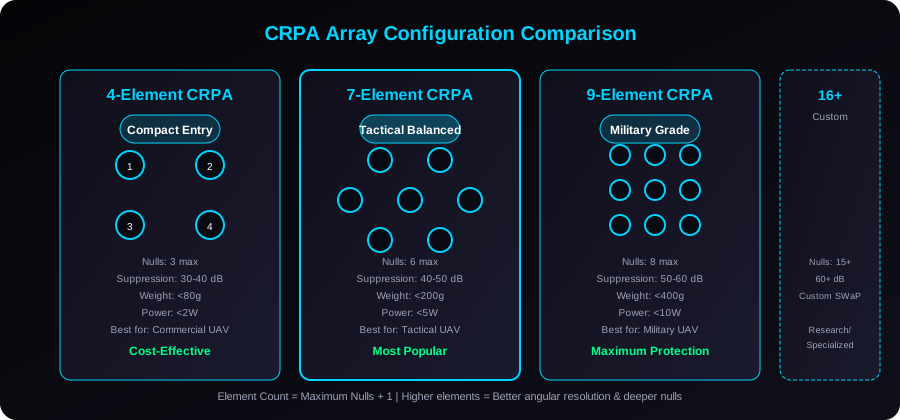
Figure 1: CRPA Array Configuration Comparison — 4-element, 7-element, 9-element, and custom 16+ element arrays
4-Element CRPA
Compact
Up to 3 nulls, 30-40 dB suppression. Ideal for small commercial/tactical UAVs with severe SWaP constraints. Cost-effective entry point.
7-Element CRPA
Balanced
Up to 6 nulls, 40-50 dB suppression. Mid-size tactical UAVs requiring robust multi-jammer protection with moderate SWaP budget.
9-Element CRPA
Maximum
Up to 8 nulls, 50-60 dB suppression. Military platforms, high-threat environments, and missions requiring maximum survivability.
2.1 Null Steering Capacity
The fundamental relationship between element count and interference suppression capability is: a CRPA with N elements can place up to N-1 independent nulls in the radiation pattern. Each null corresponds to one jamming direction.
- 4 elements: 3 nulls maximum. Sufficient for single-point jamming or limited multi-jammer scenarios. Best for civilian drones operating in low-threat environments.
- 7 elements: 6 nulls maximum. Handles simultaneous multi-directional jamming. The sweet spot for most tactical UAVs balancing protection and SWaP.
- 9+ elements: 8+ nulls maximum. Full-spectrum military protection. Essential for platforms operating in contested electronic warfare environments.
2.2 Angular Resolution and Null Depth
Higher element counts improve both the angular precision of null placement and the depth (attenuation) of each null. A 9-element CRPA can achieve null depths exceeding 50 dB with 15° angular resolution, while a 4-element system typically achieves 30-40 dB with 30° resolution. For UAVs operating at low altitudes where jammers may be close and angularly separated, higher resolution is critical.
3. Frequency Band Coverage
Modern GNSS spans multiple frequency bands, and jamming threats are increasingly multi-band. Your CRPA must protect the bands your UAV relies on.
| GNSS Band | Frequency | Primary Use | Jamming Threat |
|---|
| GPS L1 / GLONASS G1 | 1575.42 / 1602 MHz | Standard positioning | High (most jammers target L1) |
| GPS L2 / GLONASS G2 | 1227.60 / 1246 MHz | Military P(Y) code, iono correction | Medium |
| GPS L5 / Galileo E5a | 1176.45 MHz | Safety-of-life aviation | Low (emerging threat) |
| BeiDou B1 | 1561.098 MHz | Chinese constellation | Medium |
Multi-Band vs. Single-Band CRPA
Single-band (L1 only): Lowest cost, weight, and complexity. Suitable for commercial drones where only standard GPS/GLONASS L1 is used. Vulnerable to band-selective jammers.
Dual-band (L1/L2): Protects both civilian and military signals. Enables ionospheric correction for improved accuracy. Recommended for all tactical and military UAVs.
Multi-band (L1/L2/L5): Full-spectrum protection across all modernized GNSS signals. Future-proof but significantly higher SWaP and cost. Ideal for high-value military platforms.
4. SWaP Constraints for UAV Integration
Size, Weight, and Power (SWaP) are the dominant constraints for UAV CRPA integration. The table below maps typical UAV categories to feasible CRPA configurations:
| UAV Class | MTOW | Max CRPA Weight | Max Power | Recommended CRPA |
|---|
| Group 1 (Nano) | < 0.25 kg | < 20 g | < 0.5 W | 4-element mini, no beamformer |
| Group 2 (Micro) | 0.25 - 25 kg | < 100 g | < 3 W | 4-element compact |
| Group 3 (Tactical) | 25 - 600 kg | < 500 g | < 15 W | 7-element standard |
| Group 4/5 (MALE/HALE) | > 600 kg | < 2 kg | < 50 W | 9-element advanced |
4.1 Antenna Form Factor
UAV CRPA form factors vary by platform:
- Planar Arrays: Flat microstrip patch arrays, 50-80 mm diameter. Mount on top/bottom fuselage. Best for fixed-wing and VTOL UAVs with flat mounting surfaces.
- Cylindrical Arrays: 360° azimuth coverage, conical elements arranged around a cylinder. Ideal for rotary-wing (helicopter) UAVs where the antenna orientation varies.
- Conformal Arrays: Antenna elements conforming to the UAV airframe curvature. Minimizes drag and aerodynamic impact. Requires custom design per platform.
5. Performance Metrics and Validation
When evaluating CRPA products, insist on the following verified performance metrics from the manufacturer:
5.1 Anti-Jamming Performance
- Jamming-to-Signal Ratio (J/S) tolerance: The maximum J/S at which the receiver maintains lock. Tactical-grade CRPAs should achieve J/S > 60 dB for CW jamming and > 50 dB for wideband noise.
- Null depth: Minimum attenuation in the jammer direction. 40 dB null depth is considered good; 50+ dB is excellent.
- Acquisition time post-jamming: Time to reacquire satellite signals after jammer removal. Should be < 10 seconds for tactical applications.
- Beamforming latency: Time from interference detection to null placement. FPGA-based systems achieve < 1 ms; DSP-based systems may take 10-100 ms.
5.2 Navigation Performance
- Position accuracy under jamming: CEP (Circular Error Probable) during jamming vs. clean conditions. Degradation should be < 20% for well-designed systems.
- Time-to-First-Fix (TTFF) under interference: Some CRPAs may delay TTFF due to beamformer settling. Verify this metric for your mission profile.
- Multipath rejection: Improved multipath performance is a side benefit of CRPA's spatial filtering. Quantify this improvement for urban operations.
6. Integration and Certification Considerations
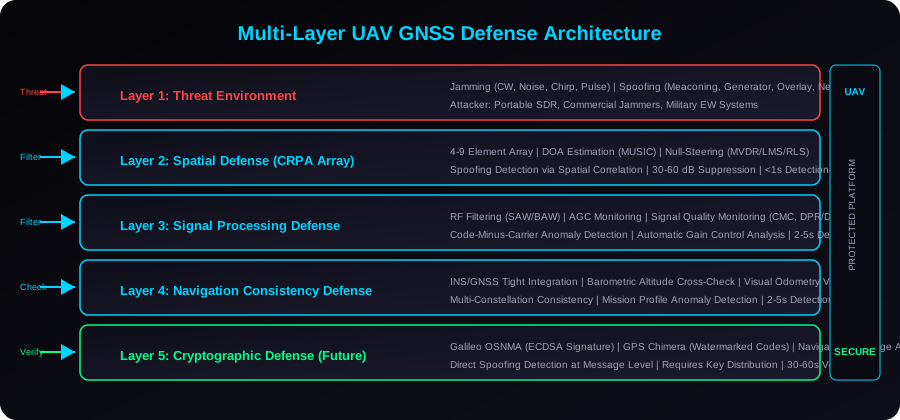
Figure 2: Multi-Layer Defense Architecture — Matching CRPA selection to overall system defense strategy
Beyond RF performance, consider integration complexity:
- Receiver interface: Does the CRPA output a standard single RF channel (compatible with off-the-shelf GNSS receivers), or does it require a multi-channel receiver with specialized beamformer interface? The former simplifies integration significantly.
- INS integration: For dynamic UAVs, CRPA attitude compensation requires INS data feed (typically at 100-200 Hz). Verify your autopilot/INS can provide this data stream.
- Environmental qualification: MIL-STD-810H for shock/vibration, MIL-STD-461 for EMI/EMC, and IP67 for environmental sealing are standard requirements for outdoor UAV operations.
- Export control: CRPA systems with advanced null-steering are often ITAR/EAR-controlled. Verify compliance for your target markets and end-users.
7. Cost-Benefit Analysis Framework
Use this framework to evaluate CRPA ROI for your UAV fleet:
- Mission value: What is the cost of losing one UAV to jamming? Include hardware replacement, payload loss, mission failure, and operational downtime.
- Threat probability: What is the likelihood of encountering GNSS interference in your operational areas? Survey local electromagnetic environment data.
- CRPA cost: Include hardware, integration, certification, and maintenance over the UAV lifecycle.
- Break-even calculation: If mission value × threat probability > CRPA cost over 3 years, CRPA investment is justified.
Get Expert CRPA Selection Support
Not sure which CRPA configuration fits your UAV platform? Our engineering team provides free technical consultations to match the optimal anti-jamming solution to your mission requirements.
View CRPA Product Catalog