In the conflict zones of 2023-2024, one statistic stood out: over 70% of FPV drone losses were attributed to electronic warfare (EW) rather than kinetic defenses. Portable GPS jammers, vehicle-mounted EW systems, and stationary electronic countermeasure stations have turned the electromagnetic spectrum into a lethal kill zone for unmanned platforms. For FPV operators, the question is no longer whether they will encounter jamming, but how quickly their navigation system will degrade—and whether their platform can survive long enough to complete the mission.
1. The FPV Drone Revolution and Its Achilles' Heel
FPV drones have transformed modern warfare through a combination of low cost, high maneuverability, and precision guidance. A typical FPV platform carries a 1-3 kg payload and operates at speeds exceeding 100 km/h. Their guidance systems rely on a multi-layer navigation architecture: GPS/GNSS provides absolute position, while inertial measurement units (IMUs) and barometric altimeters supplement during signal loss. The pilot retains manual control via video feed, making FPV drones less vulnerable to complete GPS denial than autonomous systems.
However, the FPV navigation stack has a critical vulnerability: return-to-home (RTH) and waypoint navigation modes depend entirely on GPS. When GPS is jammed, the drone loses its geospatial reference. Even if the pilot can manually control the vehicle via FPV video feed, the absence of GPS position data means the drone cannot execute pre-programmed flight paths, autonomously return to base, or accurately navigate to GPS-designated target coordinates. In contested environments where GPS is the primary targeting reference, jamming effectively neutralizes the drone's precision strike capability.
Battlefield Reality
In the Ukrainian conflict, Russian electronic warfare units deployed the R-330Zh "Zhitel" and RP-377LVM "Lorandit" systems—capable of jamming GPS across the L1 band (1575.42 MHz) with effective ranges of 5-15 km. Ukrainian FPV operators reported GPS lock loss within 30 seconds of entering contested zones, forcing a transition to manual piloting or mission abort. With a typical FPV mission duration of 3-5 minutes, 30 seconds of navigation degradation represents 10-15% of total mission time lost.
2. Electronic Warfare Threats Against FPV Drones

Figure 1: Electronic Warfare Threat Classification — Jamming and spoofing attack vectors against FPV drones in contested environments
FPV drones face a distinct threat profile compared to larger military UAVs. Their small size, low altitude operation, and high speed create unique electronic warfare vulnerabilities—and opportunities for defense.
2.1 GPS Jamming: The Primary Threat
GPS jamming remains the most prevalent and effective electronic attack against FPV platforms. The threat landscape includes:
- Portable Personal Jammers: Commercial devices that emit 1-5W of broadband noise across the L1 band. Effective range: 500m to 2km. These are widely deployed by infantry units and have become standard equipment in contested zones. A single soldier can deny GPS across a tactical area.
- Vehicle-Mounted EW Systems: Military-grade systems like the Russian R-330Zh "Zhitel" or the Ukrainian AD Counter FPV systems. These platforms generate 100-500W of jamming power across multiple bands (L1, L2, and even L5), with effective ranges of 5-20 km. They can simultaneously jam multiple frequencies and employ directional antennas to focus power on specific sectors.
- Stationary Area Denial Systems: Permanent installations around critical infrastructure, command centers, and air defense positions. These systems provide continuous 24/7 GPS denial over fixed areas, often 10-30 km in radius. They represent the highest jamming power density and the most challenging environment for FPV navigation.
2.2 GPS Spoofing: The Precision Threat
While less common than jamming due to its technical complexity, GPS spoofing against FPV drones is a growing concern. Unlike jamming, which merely denies GPS service, spoofing manipulates the drone's perceived position. An attacker can:
- Redirect the drone: By gradually shifting the counterfeit GPS position, the attacker can guide the FPV drone away from its intended target toward a false location. This is particularly effective against autonomous or semi-autonomous FPV platforms that rely on GPS waypoints.
- Trigger failsafe modes: Many FPV flight controllers enter RTH or landing mode when GPS inconsistency is detected. A spoofing attack that induces artificial GPS anomalies can trigger these failsafes, causing the drone to land prematurely or return to a spoofed "home" position.
- Geofence violation: Military and commercial FPV platforms often implement geofencing—automatic flight termination if the drone crosses predefined boundaries. Spoofing can make the drone believe it has crossed a geofence, triggering automatic descent or motor shutdown.
Spoofing Detection in FPV Platforms
CRPA arrays on FPV drones provide real-time spoofing detection through Direction-of-Arrival (DOA) consistency monitoring. Authentic GPS satellites arrive from diverse sky directions; spoofing signals originate from a single point (the attacker's antenna). A 4-element CRPA can detect this spatial anomaly within 500 milliseconds, enabling immediate pilot alert and mode transition to manual flight.
2.3 Video Link Jamming
Beyond GPS, FPV drones depend on radio frequency video links for pilot control. 5.8 GHz and 1.2 GHz analog video links are vulnerable to targeted jamming. While video link jamming does not affect navigation directly, it forces the FPV pilot to fly blind—a catastrophic failure mode for precision strike missions. Advanced FPV platforms are migrating to digital video links (DJI O3, Walksnail Avatar, HDZero) with frequency hopping and encryption, but these remain vulnerable to broadband noise jamming if the jammer power is sufficient.
3. CRPA Anti-Jamming for FPV Platforms
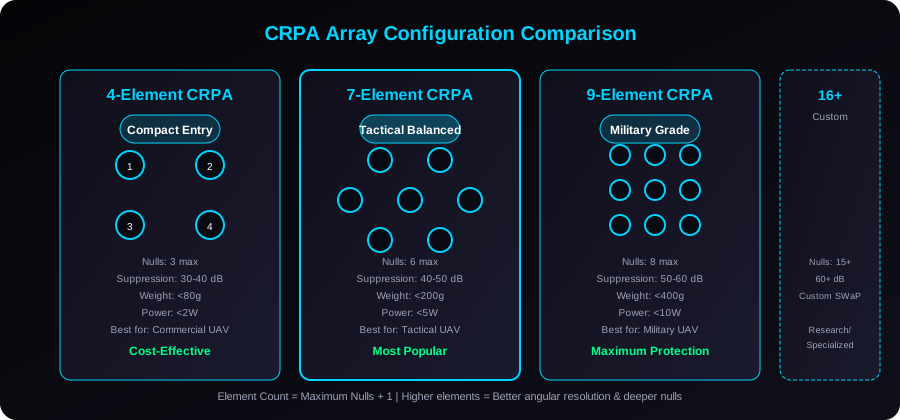
Figure 2: CRPA Array Configuration Comparison — Matching element count to FPV platform class and threat environment
The integration of CRPA (Controlled Reception Pattern Antenna) technology into FPV drones represents a paradigm shift in electronic warfare survivability. Until recently, CRPA systems were considered too large, heavy, and power-hungry for FPV platforms. Advances in RF integrated circuits (RFICs), miniature antenna design, and low-power FPGA beamformers have made CRPA protection feasible for small UAVs.
3.1 SWaP-Critical Design for FPV
FPV drones impose the most stringent Size, Weight, and Power (SWaP) constraints in the UAV ecosystem. A typical 7-inch FPV racing drone has a maximum payload capacity of 200-300g and a total flight power budget of 15-25W. CRPA integration must fit within these limits:
- Antenna Array: Microstrip patch antennas arranged in a 4-element planar configuration, typically 40-60mm in diameter. Element spacing at λ/2 (approximately 95mm at L1) requires compact miniaturization techniques—meander-line loading, high-permittivity substrates, or folded-patch topologies.
- RF Front-End: Integrated multi-channel LNA and downconverter ICs (e.g., Maxim MAX2769, u-blox NEO-M8 series with external antenna support) reduce component count. Quad-channel RF front-ends with shared LO and <2dB noise figure are now available in 10mm × 10mm QFN packages.
- Digital Beamformer: Low-power FPGA or ARM Cortex-M7 microcontroller with hardware FPU executing LMS (Least Mean Squares) adaptive beamforming. Power consumption: 1-3W. Update rate: 100-1000 Hz for null tracking.
- Weight Budget: Total CRPA system (antenna + RF + beamformer + cabling) for FPV: 80-120g. This is feasible for 7-inch and larger FPV platforms, though challenging for 5-inch racing drones.
3.2 4-Element CRPA: The FPV Standard
For FPV platforms, the 4-element CRPA configuration is the optimal balance of protection, weight, and cost. A 4-element array provides:
- 3 independent nulls: Sufficient to suppress 1-3 simultaneous jamming sources. In practice, most tactical EW environments present 1-2 primary jamming directions.
- 30-40 dB suppression: Adequate to maintain GPS lock against commercial portable jammers and moderate-power vehicle-mounted systems. Against 100W+ military jammers, suppression may be insufficient, but the CRPA enables the drone to maintain position long enough for mission completion or controlled retreat.
- 60-80g total weight: Fits within the payload envelope of 7-inch and larger FPV platforms. 5-inch platforms may require a reduced-size 3-element array with 2 nulls and 20-25 dB suppression.
- 2-3W power draw: Represents 10-20% of a typical FPV drone's power budget. Acceptable trade-off for missions in contested environments.
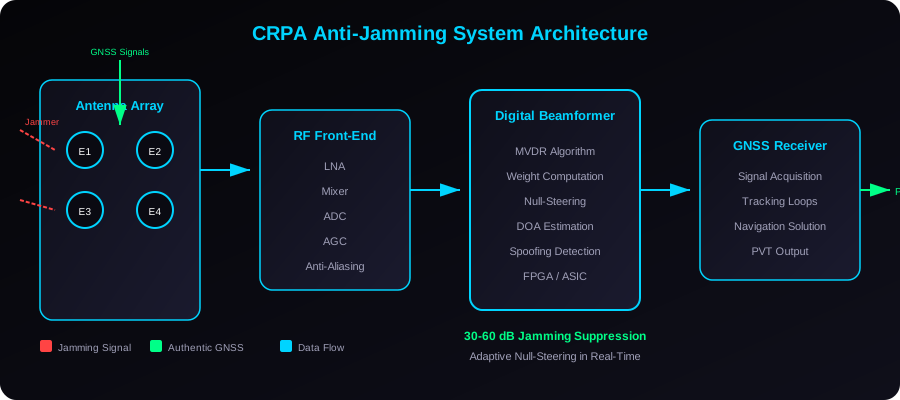
Figure 1: CRPA Anti-Jamming System Architecture for FPV Platforms — from antenna array to navigation output
3.3 Integration with FPV Flight Controllers
CRPA integration into FPV platforms requires coordination with the flight controller (FC) firmware. Modern FPV flight controllers (Betaflight, ArduPilot, INAV) provide GPS input via UART. The CRPA beamformer outputs a single RF channel that feeds the standard GNSS receiver, maintaining compatibility with existing FC firmware. However, advanced integration leverages the CRPA's spoofing detection alerts:
- Spoofing Alert Protocol: The CRPA beamformer communicates spoofing detection via a dedicated UART message or MAVLink packet. The flight controller transitions from GPS-dependent modes (position hold, RTH, waypoint) to manual or barometric modes.
- Jammer Direction Reporting: CRPA DOA estimation can report jammer direction to the pilot's OSD (On-Screen Display), providing situational awareness: "GPS Jamming — Source: 270° (West)." This enables tactical decision-making: evade, abort, or continue manually.
- Adaptive Mission Planning: For autonomous FPV missions, pre-flight waypoints can be annotated with predicted jamming zones. The flight controller selects routes that minimize GPS exposure or accelerates through high-threat segments with CRPA-enhanced protection.
4. Operational Tactics: FPV EW Survival
Technology alone is insufficient. FPV operators must combine CRPA hardware with tactical adaptations to maximize survivability in electronic warfare environments.
| Tactic | Description | Effectiveness | Limitation |
|---|
| Low Altitude Penetration | Fly below 50m to exploit terrain masking against directional jammers | High vs. directional EW | Increased MANPAD risk |
| High-Speed Transit | Maximize speed through jamming zones (150+ km/h) | Moderate | Reduced precision |
| Multi-Band GNSS | Use GPS + GLONASS + BeiDou simultaneously | High vs. band-selective jammers | Requires multi-band CRPA |
| Visual Targeting | Manual FPV guidance without GPS waypoints | Very High | Requires skilled pilot |
| CRPA Protection | Deploy 4-element CRPA with null-steering | High (30-40 dB) | SWaP penalty |
| Jammer Homing | Use CRPA DOA to locate and attack jammer source | Tactical advantage | High risk |
5. Commercial FPV vs. Military FPV: Different Protection Profiles
The FPV ecosystem spans a wide spectrum from consumer racing drones to military strike platforms. CRPA requirements differ significantly across this spectrum.
5.1 Consumer/Racing FPV (5-7 inch)
Threat model: Occasional GPS jamming from urban interference, hobbyist jammer testing, or low-level commercial disputes. Not designed for military EW environments.
CRPA recommendation: Optional 3-4 element compact array (60-80g) with basic null-steering. Priority: maintain GPS lock during RTH in urban environments with multipath and interference. Not a hard requirement for most recreational pilots.
5.2 Commercial/Industrial FPV (7-10 inch)
Threat model: Industrial GPS interference from construction equipment, mining operations, and urban RF congestion. Also relevant for commercial operations in regions with GPS jamming (e.g., Middle East, Eastern Europe, conflict-adjacent areas).
CRPA recommendation: 4-element standard array (80-100g) with adaptive null-steering. Priority: maintain mission continuity in industrial RF environments, enable BVLOS (Beyond Visual Line of Sight) operations with reliable GPS.
5.3 Military/Tactical FPV (8-10 inch, heavy payload)
Threat model: Active military electronic warfare: vehicle-mounted jammers, stationary area denial systems, coordinated multi-band jamming, and potential spoofing. These are the most demanding electromagnetic environments.
CRPA recommendation: 4-element high-performance array (100-120g) with advanced beamforming (MVDR or RLS), spoofing detection, multi-band protection (L1/L2), and INS integration. Priority: maximize GPS survivability to enable precision strike, autonomous RTH, and jammer direction-finding for counter-EW targeting.
6. The Future: AI-Enhanced FPV EW Defense
Emerging technologies promise to further enhance FPV drone survivability in electronic warfare environments:
- AI-Predictive Jammer Avoidance: Machine learning models trained on battlefield EW data to predict jammer locations and dynamically reroute FPV missions before GPS degradation occurs. Integration with swarm intelligence enables distributed jammer mapping across multiple FPV platforms.
- Software-Defined CRPA: SDR-based CRPA platforms enabling field-upgradable jammer waveform recognition and adaptive countermeasures. New jammer types can be characterized and added to the beamformer's threat library within hours, not months.
- Quantum-Enhanced RF Sensing: Rydberg atom-based RF sensors offer unprecedented sensitivity for detecting ultra-weak jamming signals and precise direction-of-arrival estimation. While still laboratory-scale, quantum sensors may eventually enable miniature CRPA systems with 100+ dB dynamic range.
- Optical Navigation Backup: Visual-inertial odometry (VIO) and event-based cameras provide GPS-independent navigation at high frame rates. Combined with CRPA-protected GPS, optical navigation creates a robust multi-sensor fusion architecture that can operate even when GPS is completely denied.
7. Conclusion: The New FPV Battlefield
The FPV drone has fundamentally changed warfare, but electronic warfare has simultaneously changed the FPV battlefield. GPS jamming is no longer a theoretical threat—it is the dominant cause of FPV mission failure in contested environments. CRPA anti-jamming technology offers a path to restore navigation integrity, enabling FPV drones to operate with the precision and reliability that their missions demand.
For FPV operators, the calculus is clear: invest in CRPA protection or accept GPS vulnerability. In electronic warfare environments where GPS denial is the norm, not the exception, CRPA-equipped FPV platforms will be the only ones that can reliably execute precision missions, return to base, and survive the electromagnetic battlefield.
Protect Your FPV Fleet
GMC CRPA delivers compact, SWaP-optimized anti-jamming and anti-spoofing protection specifically engineered for FPV and tactical UAV platforms. From 4-element entry arrays to advanced multi-band configurations, we match the right CRPA solution to your mission profile.
Explore FPV CRPA Solutions